
Why Is the Antminer E9Pro Water Cooling Plate Upgrade Kit Essential for More Stable Mining Operations?
Article Summary
The Antminer E9Pro is a powerful ASIC mining machine designed for demanding computing workloads. However, continuous operation generates substantial heat, making thermal management an important consideration for mining facilities. The Antminer E9Pro Water Cooling Plate Upgrade Kit provides a liquid-cooling conversion solution designed to transfer heat away from the miner's hash boards through circulating coolant. By replacing the conventional air-cooling arrangement with a properly configured liquid-cooling system, operators can improve heat management, reduce dependence on high-speed cooling fans, and create a more controlled mining environment.
This article explores how a water cooling plate upgrade works, the practical benefits it can offer, important compatibility considerations, installation requirements, maintenance practices, and the factors buyers should evaluate before purchasing a cooling upgrade kit.
Article Contents
- Why Does Antminer E9Pro Cooling Matter?
- What Is an Antminer E9Pro Water Cooling Plate Upgrade Kit?
- How Does the Water Cooling Plate Work?
- Why Upgrade from Air Cooling to Water Cooling?
- What Problems Can a Water Cooling Upgrade Address?
- Key Components and Their Functions
- Important Factors When Choosing an Upgrade Kit
- Installation Considerations for E9Pro Miners
- Maintenance Tips for Long-Term Cooling Performance
- Air Cooling vs. Water Cooling: A Practical Comparison
- Why Work with an Experienced Cooling Solution Supplier?
- Frequently Asked Questions
- Conclusion
1. Why Does Antminer E9Pro Cooling Matter?
Mining equipment is expected to operate continuously, often for extended periods without interruption. During this process, electrical energy is converted into computing power, and a considerable amount of energy is released as heat. If this heat is not removed effectively, internal temperatures may rise and affect the operating conditions of critical electronic components.
The Bitmain Antminer E9Pro is rated at approximately 3,680 MH/s hashrate and 2,200 W power consumption under its published typical operating conditions. These specifications demonstrate why an appropriate thermal management strategy matters for mining operators.
When cooling capacity does not match the heat generated by a mining machine, several operational challenges may occur:
- High operating temperatures: Insufficient heat removal can increase the thermal load on hash boards and other components.
- Cooling fan noise: Conventional air-cooled miners may require high-speed fans to maintain acceptable temperatures.
- Environmental heat accumulation: Multiple miners operating in one room can create a substantial cooling burden.
- Maintenance pressure: Dust accumulation, blocked airflow, and fan wear can make cooling management more complicated.
- Operating instability: Excessive temperatures may trigger protective mechanisms or contribute to abnormal operating conditions.
For mining facilities looking to improve their thermal management arrangements, a dedicated water cooling plate upgrade is worth evaluating. It provides another way to transfer heat away from the hash boards and manage the thermal demands of continuous mining operations.
Key consideration: A cooling upgrade should be evaluated as part of the entire thermal management system. The cooling plate, pump, radiator, coolant flow, and installation quality all contribute to the final result.
2. What Is an Antminer E9Pro Water Cooling Plate Upgrade Kit?
An Antminer E9Pro Water Cooling Plate Upgrade Kit is a specialized cooling conversion solution designed for compatible E9Pro mining hardware. Its primary purpose is to replace or modify the original air-cooling heat dissipation arrangement with a liquid-based heat transfer system.
Unlike conventional cooling fans that move air across heat sinks, a water cooling plate creates a heat transfer interface between the mining hardware and a circulating liquid cooling loop. The coolant absorbs heat from the plate and transports it to a radiator or another heat rejection device.
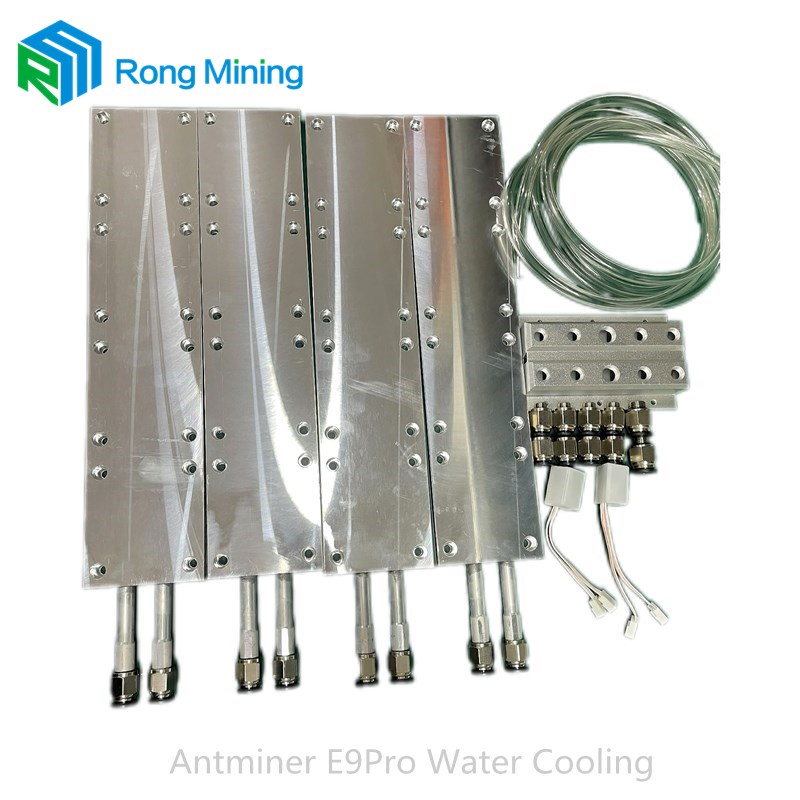
Depending on the supplier and package configuration, an upgrade kit may include:
- Aluminum alloy water cooling plates.
- Coolant distribution components or water manifolds.
- Connecting hoses and fittings.
- A compatible circulation pump.
- A radiator or liquid heat exchanger.
- Thermal interface materials.
- Installation accessories and related components.
Not every package contains all these components. Some suppliers offer water cooling plates separately, while others provide a more complete conversion package with a radiator and additional accessories. Buyers should confirm the exact bill of materials before placing an order.
Designed Around the E9Pro Hash Board Structure
One of the most important characteristics of a mining cooling plate is its compatibility with the target hash board. The plate must match the physical layout and heat transfer requirements of the intended hardware.
A correctly matched cooling plate helps establish effective contact with the designated thermal surfaces. This allows heat to move from the hash board into the circulating coolant. Incorrect dimensions, mounting positions, or contact pressure can reduce thermal performance and may create installation risks.
For this reason, buyers should confirm the exact E9Pro model, hash board revision, and chip layout with the supplier rather than relying only on the miner's external model name.
3. How Does the Water Cooling Plate Work?
The operating principle of a water cooling plate is based on controlled heat transfer and liquid circulation. Instead of relying exclusively on moving air, the system uses a coolant loop to collect heat at the mining hardware and release it through a radiator.
Step 1: Heat Is Transferred from the Hash Board
During mining operations, ASIC chips generate heat. A properly designed water cooling plate is installed against the designated heat transfer surfaces, with suitable thermal interface material used to reduce contact resistance.
The plate receives heat from the hardware through conduction. Its internal liquid channels provide a pathway for heat to move into the circulating coolant.
Step 2: Coolant Circulates Through the Cooling Plate
A pump moves coolant through the plate's internal channels. As the liquid passes through the heat exchange area, it absorbs thermal energy from the plate.
Consistent coolant circulation is essential. Flow restrictions, trapped air, incorrect hose connections, or pump failure can reduce cooling capacity and affect the operating temperature of the mining equipment.
Step 3: The Radiator Releases Heat
After absorbing heat, the coolant travels toward a radiator or heat exchanger. Heat is transferred from the liquid to the surrounding environment, allowing the coolant temperature to decrease before returning to the cooling plate.
Step 4: The Cooling Cycle Continues
The pump maintains circulation through the closed or appropriately configured cooling loop. As long as the system operates within its design limits, heat can be continuously transported away from the mining hardware.
Cooling principle: Hash board heat → Water cooling plate → Circulating coolant → Radiator → Heat released into the environment.
This arrangement makes liquid cooling particularly useful when mining operators need a more organized heat transfer solution for high-density equipment installations.
4. Why Upgrade from Air Cooling to Water Cooling?
Air cooling remains a practical solution for many mining installations. However, as operating environments become more demanding, conventional airflow-based cooling may create additional challenges related to noise, ventilation, dust, and heat distribution.
4.1 More Direct Heat Transfer
Liquid cooling transfers heat through a plate in direct contact with designated hardware surfaces. Compared with relying solely on airflow around conventional heat sinks, this approach provides a more controlled heat transfer pathway.
Actual performance depends on plate design, coolant flow, thermal interface quality, radiator capacity, and ambient temperature. A water cooling conversion should therefore be matched to the complete cooling requirements of the E9Pro.
4.2 Reduced Dependence on High-Speed Fan Cooling
Traditional air-cooled mining equipment can produce considerable noise because cooling fans need to move large volumes of air. A liquid cooling conversion can reduce the need for high-speed airflow through the miner, potentially lowering equipment-related fan noise.
However, the pump and radiator fans may still generate noise. The overall sound level depends on the complete installation rather than the cooling plate alone.
4.3 Improved Thermal Management in Dense Mining Environments
When multiple mining machines operate in a confined area, hot exhaust air can accumulate and make temperature management more difficult. Liquid cooling provides a different way to collect and transport heat away from individual machines.
With an appropriately sized radiator and ventilation or heat rejection arrangement, mining operators can organize heat removal more effectively.
4.4 Greater Flexibility for Cooling System Design
A water cooling configuration allows operators to consider centralized radiators, dedicated circulation loops, and customized cooling layouts. This flexibility can be valuable for facilities that need to adapt their cooling infrastructure to different equipment quantities and installation conditions.
4.5 Potentially Easier Management of the Equipment Environment
Because the system does not depend exclusively on large volumes of air passing through the miner, operators may have more flexibility when managing dust and airflow in the mining room. Nevertheless, dust control remains necessary for exposed components, radiator surfaces, and surrounding electrical equipment.
5. What Problems Can a Water Cooling Upgrade Address?
Before purchasing a cooling upgrade kit, it is useful to identify the specific problems experienced by the mining facility. Different cooling challenges may require different system configurations.
Problem 1: Excessive Operating Temperature
When hash board temperatures approach the equipment's thermal limits, operators need to investigate the root cause. Possible factors include insufficient ventilation, high ambient temperature, blocked cooling surfaces, or inadequate cooling capacity.
A correctly designed water cooling conversion can provide an additional heat removal pathway. However, it cannot compensate for an undersized radiator, poor coolant circulation, or an unsuitable installation.
Problem 2: High Noise Levels
Mining facilities located near residential areas, offices, or other working environments may be particularly concerned about noise. Replacing some of the original fan-based cooling demand with liquid cooling can help reduce the noise associated with high-speed miner fans.
For the best results, the complete system should be evaluated, including pump noise, radiator fans, vibration, and equipment mounting.
Problem 3: Difficult Heat Management in Multiple-Miner Installations
When several E9Pro units operate together, their combined heat output can place significant demands on room ventilation and air conditioning. A liquid cooling arrangement may help organize heat collection and distribution more efficiently.
Problem 4: Limited Cooling Flexibility
Some mining facilities need to adapt their equipment layout because of space limitations or changing operating requirements. A water cooling plate upgrade creates additional possibilities for designing a cooling loop around the available infrastructure.
Problem 5: Increasing Cooling Maintenance Requirements
Air-cooled systems require regular attention to fan condition, airflow pathways, and dust accumulation. Liquid cooling introduces different maintenance requirements, such as checking coolant quality, hose connections, pump operation, and radiator cleanliness.
The objective is not to eliminate maintenance, but to adopt a cooling arrangement that better matches the facility's operating conditions and management capabilities.
6. Key Components and Their Functions
Understanding the main components of an E9Pro water cooling upgrade kit helps buyers evaluate whether a proposed package meets their actual installation requirements.
| Component | Main Function | What Buyers Should Check |
|---|---|---|
| Water Cooling Plate | Transfers heat from designated hash board surfaces to the coolant. | Dimensions, material, channel design, mounting compatibility, and sealing quality. |
| Circulation Pump | Moves coolant through the cooling loop. | Flow rate, pressure capability, electrical requirements, and reliability. |
| Radiator | Releases absorbed heat into the surrounding environment. | Heat rejection capacity, airflow, installation space, and operating conditions. |
| Water Hoses | Connect cooling components and transport coolant. | Diameter, temperature resistance, pressure rating, and connection compatibility. |
| Manifold and Fittings | Distribute coolant and connect different sections of the loop. | Port dimensions, sealing structure, and connection configuration. |
| Thermal Interface Material | Improves heat transfer between the hardware and cooling plate. | Thermal properties, application method, and compatibility. |
Some upgrade packages also include additional accessories required for a particular conversion design. The exact configuration should always be confirmed before purchase.
7. Important Factors When Choosing an Upgrade Kit
Selecting an appropriate Antminer E9Pro Water Cooling Plate Upgrade Kit involves more than comparing prices. Buyers should evaluate technical compatibility, cooling capacity, manufacturing quality, and the supplier's ability to provide product support.
7.1 Confirm the Exact Miner and Hash Board Version
Compatibility is the first purchasing priority. Even when two products carry the same miner model name, hardware revisions or board configurations may differ.
Before ordering, prepare the following information:
- Antminer model and version.
- Hash board revision or identification details.
- Number and arrangement of hash boards.
- Chip layout and relevant mounting dimensions.
- Photos of the original cooling arrangement, if available.
Providing this information helps the supplier determine whether the proposed plate matches the intended hardware.
7.2 Evaluate the Water Cooling Plate Material
Aluminum alloy is commonly used in liquid cooling plates because it combines relatively low weight, good thermal conductivity, and practical machinability.
However, material selection alone does not determine product quality. Buyers should also consider machining accuracy, internal channel design, surface flatness, wall thickness, and corrosion compatibility with the selected coolant and other loop materials.
7.3 Check Manufacturing and Sealing Quality
A cooling plate must maintain reliable coolant containment during operation. Poor machining, defective joints, or inadequate sealing can lead to leakage and potential damage to electronic equipment.
Ask suppliers about their manufacturing process and inspection procedures. Useful quality checks may include dimensional inspection, sealing inspection, and appropriate pressure or leak testing under defined conditions.
7.4 Match Radiator Capacity to Actual Heat Load
A water cooling plate cannot deliver its intended performance without sufficient heat rejection capacity. The radiator must be selected according to the heat load, coolant flow, inlet temperature, ambient conditions, and available airflow.
Do not assume that a radiator advertised with a particular capacity will automatically provide the same result in every mining environment. Ask for the operating conditions behind the stated rating.
7.5 Consider Pump Performance and Flow Resistance
The circulation pump must provide adequate flow through the cooling plates, hoses, manifolds, and radiator. A pump with insufficient pressure capability may struggle when the loop contains several restrictions.
Ask the supplier for pump specifications and recommended loop configurations rather than selecting a pump based only on its maximum advertised flow rate.
7.6 Review Supplier Support and Customization
Professional suppliers should be able to explain product compatibility, package contents, installation requirements, and maintenance considerations. For buyers managing multiple mining machines, customization and consistent replacement-part supply may also be important.
Purchasing tip: Request product drawings, actual product photographs, a complete component list, and compatibility confirmation before confirming a bulk order.
8. Installation Considerations for E9Pro Miners
Installing a water cooling plate upgrade involves modifying the miner's original cooling arrangement. Because the process affects sensitive electronic hardware and introduces circulating liquid near electrical components, installation should be performed by qualified personnel familiar with ASIC mining equipment.
Step 1: Verify the Hardware Configuration
Confirm the miner model, hash board version, plate dimensions, mounting positions, and included accessories. Do not proceed if the cooling plate's compatibility has not been established.
Step 2: Prepare the Cooling Infrastructure
Check that the pump, radiator, hoses, fittings, coolant, and power supply arrangements are suitable for the planned installation. Ensure that the cooling system has sufficient capacity for the intended heat load.
Step 3: Inspect the Cooling Plate
Before installation, inspect the plate for visible damage, machining defects, contamination, and sealing issues. Confirm that the connecting ports and mounting points correspond to the intended configuration.
Step 4: Apply Appropriate Thermal Interface Material
Thermal interface material should be applied according to the plate manufacturer's instructions. Uneven contact or excessive application may interfere with proper heat transfer and mechanical installation.
Step 5: Complete the Cooling Loop
Qualified technicians should connect the hoses, manifolds, pump, and radiator according to the approved system layout. Connections must be properly secured, and the circulation direction should be checked.
Step 6: Perform Leak and Flow Checks
Before powering the miner, inspect the cooling loop for leakage and verify coolant circulation. Use the manufacturer's recommended testing procedure and keep electronic components protected during all checks.
Step 7: Monitor Temperatures During Initial Operation
After the installation has been inspected and approved, monitor coolant temperature, hash board temperatures, pump operation, and any available equipment alerts. Compare the readings against the miner's operating requirements and the cooling system manufacturer's recommendations.
Never operate the miner with an unverified cooling loop or ignore abnormal temperature readings, coolant leakage, or pump alarms.
9. Maintenance Tips for Long-Term Cooling Performance
A liquid cooling system requires regular inspection to maintain consistent operation. Although the cooling plate reduces dependence on conventional airflow-based heat transfer, the overall system still contains components that can wear, become contaminated, or lose performance over time.
Inspect Coolant Condition
Check the coolant according to the fluid manufacturer's recommended maintenance schedule. Contamination, unsuitable fluid chemistry, or incompatible additives may contribute to corrosion, deposits, or reduced heat transfer.
Check Hoses and Connections
Inspect hose surfaces, clamps, fittings, and connection points for leakage, deformation, cracking, or looseness. Replace damaged components before they affect the cooling loop.
Monitor Pump Operation
Observe pump noise, vibration, flow performance, and operating temperature. Unusual sounds or inconsistent circulation may indicate a developing problem.
Keep the Radiator Clean
Dust and debris can accumulate on radiator surfaces and restrict airflow. Regular cleaning helps preserve heat rejection performance. Follow the radiator manufacturer's cleaning instructions.
Monitor Operating Data
Maintain records of hash board temperatures, coolant inlet and outlet temperatures, ambient conditions, and any abnormal operating events. Comparing historical readings can help identify changes in cooling performance before they become serious problems.
| Inspection Item | Recommended Focus | Purpose |
|---|---|---|
| Coolant | Condition, contamination, and replacement schedule. | Maintain suitable liquid properties. |
| Water Hoses | Cracks, leaks, and loose connections. | Reduce leakage risks. |
| Water Pump | Flow, noise, and vibration. | Maintain circulation. |
| Radiator | Dust, airflow, and heat rejection. | Support effective heat dissipation. |
| Cooling Plate | Mounting, sealing, and visible damage. | Maintain reliable heat transfer. |
| Temperature Data | Coolant and hash board temperature trends. | Identify abnormal operating conditions. |
10. Air Cooling vs. Water Cooling: A Practical Comparison
Both air cooling and water cooling can be used to manage mining equipment temperatures. The right solution depends on the facility's operating environment, maintenance capabilities, cooling infrastructure, and performance requirements.
| Comparison Factor | Traditional Air Cooling | Water Cooling Upgrade |
|---|---|---|
| Heat Transfer Method | Airflow across heat sinks and components. | Heat transfer through a liquid cooling plate and circulating coolant. |
| Noise Sources | Primarily miner cooling fans. | Pump and radiator fans may generate noise; miner fan noise may be reduced depending on configuration. |
| Airflow Demand | Requires sufficient airflow through the miner and mining room. | Reduces dependence on airflow through the miner but still requires heat rejection from the radiator. |
| Installation | Generally uses the original factory cooling arrangement. | Requires compatible plates, plumbing, circulation equipment, and proper installation. |
| Maintenance Focus | Fans, heat sinks, dust, and ventilation. | Coolant, pump, hoses, fittings, radiator, and sealing. |
| Cooling Infrastructure | Air conditioning and ventilation systems. | Liquid circulation and appropriate heat rejection equipment. |
| Best Application | Facilities with suitable ventilation and manageable environmental conditions. | Facilities seeking a liquid-based heat transfer arrangement and greater cooling layout flexibility. |
Neither method is universally superior. A properly maintained air cooling system may be sufficient for many installations, while a water cooling conversion may be more appropriate when operators need to address specific noise, airflow, or heat management challenges.
11. Why Work with an Experienced Cooling Solution Supplier?
Choosing the right product is only one part of a successful cooling upgrade. The supplier's technical understanding, manufacturing capability, quality control, and after-sales support can also influence the overall purchasing experience.
Shenzhen Xinjinyi Technology Co., Ltd. focuses on mining equipment cooling solutions and related accessories. For buyers looking for an Antminer E9Pro Water Cooling Plate Upgrade Kit, working with a supplier that understands mining hardware and cooling system requirements can make product selection and technical communication more efficient.
Product Compatibility Assistance
Mining equipment can involve different hardware revisions and cooling configurations. Confirming the intended miner and hash board details before production or shipment helps reduce compatibility problems.
Manufacturing and Quality Control
Cooling plate manufacturing requires attention to dimensional accuracy, channel structure, material selection, and sealing performance. A consistent inspection process helps ensure that products meet their specified requirements.
Customized Cooling Solutions
Different mining facilities may have different installation layouts and cooling requirements. Custom product discussions can cover dimensions, connection positions, accessories, and cooling loop configurations where technically feasible.
Technical Communication and After-Sales Support
Clear product documentation, installation guidance, and responsive communication help buyers manage procurement and equipment maintenance more effectively.
For distributors, mining farm operators, equipment repair businesses, and bulk purchasers, these factors are worth considering alongside product price and delivery time.
12. Frequently Asked Questions
Q1: What is the main purpose of the Antminer E9Pro Water Cooling Plate Upgrade Kit?
The kit is designed to convert a compatible Antminer E9Pro from its original air-cooling arrangement to a liquid-based cooling configuration. It transfers heat from designated hash board surfaces into circulating coolant, which then carries the heat to a radiator or heat exchanger.
Q2: Can the water cooling plate upgrade kit fit every Antminer E9Pro?
Compatibility should be confirmed before purchasing. Buyers should provide the exact miner version, hash board revision, chip layout, and relevant mounting details. A product designed for one board configuration should not automatically be assumed compatible with another.
Q3: Does water cooling improve mining performance?
Water cooling can help maintain more controlled operating temperatures when the system is correctly designed and installed. However, it does not automatically increase the miner's rated hashrate. Actual performance depends on hardware condition, firmware settings, power supply, ambient conditions, and operating configuration.
Q4: Does the upgrade kit include a radiator and water pump?
Package contents vary by supplier. Some products include only the cooling plates, while complete packages may include a radiator, pump, hoses, fittings, and other accessories. Always request a detailed component list before ordering.
Q5: Can water cooling reduce Antminer E9Pro operating noise?
It can reduce dependence on the miner's original high-speed cooling fans, potentially lowering fan-related noise. However, the pump and radiator fans also generate sound, so the final noise level depends on the complete cooling system design.
Q6: What material is commonly used for mining water cooling plates?
Aluminum alloy is commonly used because of its thermal conductivity, relatively low weight, and machining flexibility. Buyers should also evaluate the plate's internal channel design, surface finish, sealing structure, and compatibility with the selected coolant.
Q7: Is special maintenance required for a liquid cooling system?
Yes. Maintenance generally includes checking coolant condition, pump operation, hose connections, radiator cleanliness, and possible leakage. The maintenance interval should follow the cooling system and coolant manufacturers' recommendations.
Q8: Can a water cooling plate be installed without professional assistance?
Professional installation is strongly recommended. The conversion involves sensitive electronic components and a liquid circulation system. Incorrect installation or leakage may damage the mining equipment. Qualified technicians should perform compatibility checks, installation, and leak testing.
Q9: What information should I provide when requesting a quotation?
Provide the miner model, hash board revision, required quantity, destination country, and whether you need cooling plates only or a complete cooling package. Photos of the original hardware and the intended installation environment can also help the supplier recommend a suitable configuration.
Q10: Is the Antminer E9Pro Water Cooling Plate Upgrade Kit suitable for mining farms?
It can be considered for mining farms that want to introduce liquid cooling to compatible E9Pro equipment. Before large-scale purchasing, operators should evaluate cooling capacity, installation space, power requirements, maintenance resources, and total operating costs.
Conclusion: Is a Water Cooling Upgrade Worth Considering?
Effective thermal management is essential for mining equipment that operates continuously under demanding workloads. As mining facilities expand and cooling requirements become more complex, conventional air cooling may not always provide the most suitable arrangement for every operating environment.
The Antminer E9Pro Water Cooling Plate Upgrade Kit offers an alternative heat transfer solution by combining a dedicated cooling plate with a circulating liquid system. When correctly matched to the miner's hardware and supported by an appropriately sized pump, radiator, and cooling loop, it can help improve temperature management, reduce reliance on high-speed miner fans, and provide greater flexibility for mining facility design.
However, successful upgrading depends on more than the cooling plate itself. Hardware compatibility, manufacturing quality, installation accuracy, coolant circulation, and regular maintenance all deserve careful attention.
For mining farm operators, distributors, and equipment service providers, choosing a reliable supplier and confirming the complete technical configuration before purchasing are important steps toward a successful cooling conversion.
Looking for a Reliable Antminer E9Pro Water Cooling Plate Upgrade Kit?
Improve your mining equipment cooling arrangement with a solution that matches your hardware and operating requirements. Shenzhen Xinjinyi Technology Co., Ltd. welcomes inquiries from mining farm operators, wholesalers, distributors, and industrial buyers.
Whether you need individual water cooling plates, complete upgrade kits, bulk quantities, or customized cooling solutions, our team can help you discuss product specifications and suitable configurations.
Contact us today with your Antminer E9Pro model, hash board details, and purchasing requirements to request product information and a quotation.
Contact UsSend Inquiry



X
We use cookies to offer you a better browsing experience, analyze site traffic and personalize content. By using this site, you agree to our use of cookies.
Privacy Policy