
How Does the S19jpro 104T Water Cooled Plate Kit Improve Cooling?
Article Summary
The S19jpro 104T Aluminum Substrate Water Cooled Plate Kit is designed for buyers who want to explore liquid cooling as an alternative to conventional air-based heat dissipation for compatible ASIC mining hardware. By transferring heat from the hashboard assembly to circulating coolant, a properly designed liquid cooling system can help manage thermal loads and reduce dependence on high-speed cooling fans. Successful deployment depends on hashboard compatibility, contact quality, coolant circulation, heat exchanger capacity, leak prevention, and correct installation. This guide explains the main components, selection criteria, installation considerations, maintenance requirements, and purchasing questions that mining farm operators, repair businesses, and equipment distributors should evaluate before ordering.
What This Guide Covers
- Product construction and the basic liquid cooling principle.
- Practical benefits and limitations of aluminum cooling plates.
- Compatibility, installation safety, and cooling loop requirements.
- Supplier evaluation, quality checks, and procurement planning.
01 · Product Overview
Understanding the S19jpro 104T Aluminum Substrate Water Cooled Plate Kit
ASIC miners perform intensive calculations continuously, generating substantial heat within a compact hardware enclosure. When heat cannot be removed effectively, component temperatures may rise, cooling fans may work harder, and the system may experience thermal instability or protective throttling under certain conditions.
The S19jpro 104T Aluminum Substrate Water Cooled Plate Kit is intended for liquid cooling conversion projects involving compatible Antminer S19j Pro 104T hardware. Its aluminum cooling plates provide a heat transfer interface between the target board assembly and the circulating coolant system.
Unlike a standalone radiator, a water-cooled plate is only one part of the complete thermal management solution. A functioning installation also needs a suitable coolant circulation arrangement, appropriate hoses and connections, and a heat exchanger capable of handling the actual thermal load.
For Shenzhen Xinjinyi Technology Co., Ltd., this product category serves buyers investigating ASIC miner cooling components, replacement parts, and hardware upgrade projects. Before placing an order, customers should confirm the exact board revision and kit configuration with the supplier.
Important distinction: The water-cooled plate transfers heat; it does not independently eliminate that heat. The external cooling loop must transport and reject the thermal energy effectively.
02 · Thermal Engineering
Why Thermal Management Matters for ASIC Miners
Mining hardware is often operated for extended periods, making thermal management an important part of equipment maintenance and facility planning. A suitable cooling strategy helps operators manage operating temperatures while accounting for ambient conditions, power consumption, noise, and service access.
Managing Continuous Heat Generation
During operation, ASIC chips and associated board components generate heat that must move through the cooling interface and into the surrounding cooling medium. Poor contact, inadequate flow, restricted passages, or insufficient heat exchanger capacity can limit the effectiveness of the entire system.
Reducing Dependence on High-Speed Fans
Traditional air-cooled miners commonly use high-speed fans to push air through heat sinks. Liquid cooling can reduce reliance on the original high-speed fan arrangement when the conversion is properly engineered. However, pumps, radiators, and their fans may still produce noise, so the complete system should be evaluated rather than the miner alone.
Supporting Stable Operation
Consistent heat removal can help maintain suitable operating conditions for compatible hardware. Actual results depend on coolant temperature, flow rate, thermal interface quality, system configuration, and environmental conditions. A water-cooling upgrade should not be treated as a guarantee of higher hashrate or lower total energy consumption.
Planning for High-Density Mining Environments
Mining facilities must account for heat rejection, airflow around radiators, equipment spacing, plumbing routes, and maintenance access. Liquid cooling can change how heat is distributed throughout a facility, but the external loop must be designed to handle the total load of all connected machines.
03 · System Components
Key Components and Their Functions
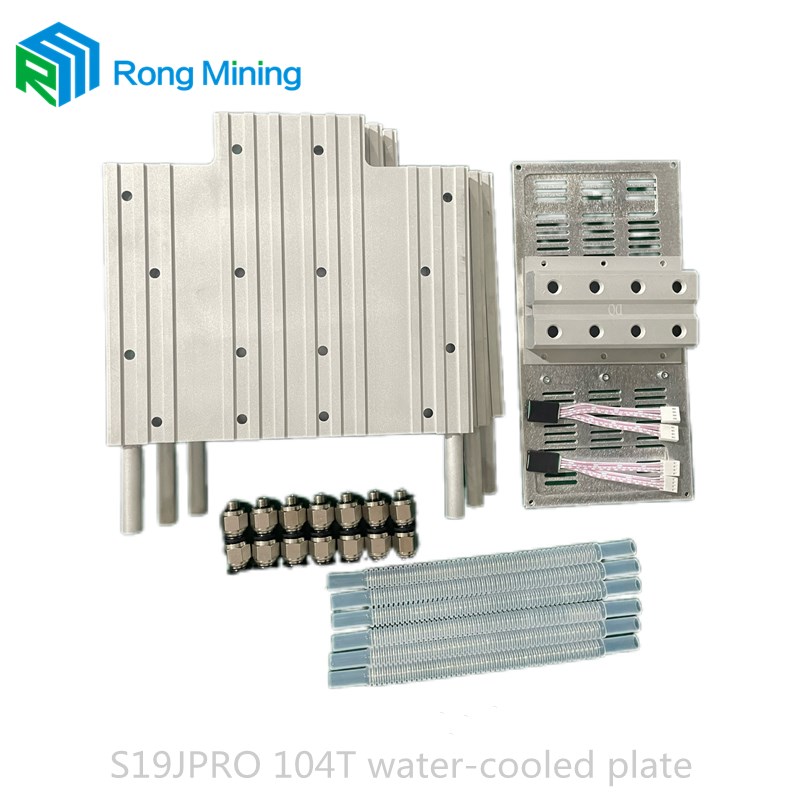
The exact contents of the S19jpro 104T Aluminum Substrate Water Cooled Plate Kit should be confirmed against the supplier's current packing list. Depending on the specific configuration, a conversion kit may include the following components.
| Component | Main Function | What Buyers Should Check |
|---|---|---|
| Aluminum water-cooling plates | Transfer heat away from compatible board components | Board compatibility, dimensions, flatness, channel design, and finish |
| Water distribution manifold | Distributes coolant between connected cooling branches | Port arrangement, flow path, sealing, and connector compatibility |
| Coolant hoses and fittings | Carry coolant through the cooling loop | Hose diameter, pressure rating, temperature rating, and leak resistance |
| Fasteners and mounting parts | Secure the cooling plates to the intended assembly | Correct dimensions, quantity, mounting sequence, and tightening requirements |
| Thermal interface material | Reduces gaps between designated contact surfaces | Material suitability, application instructions, and required quantity |
| External cooling equipment | Circulates coolant and rejects heat from the system | Whether the pump, radiator, reservoir, and controls are included or purchased separately |
Not every kit includes all these items. Some products supply only the plates and basic plumbing accessories, while others are packaged as more comprehensive conversion solutions. A detailed packing list helps prevent missing parts and unexpected project costs.
04 · Design Advantages
Main Benefits of Aluminum Water Cooling Plates
Effective Heat Transfer Potential
Aluminum is widely used in thermal management because of its useful thermal conductivity, relatively low density, and suitability for machining. A properly designed aluminum plate can transfer heat into a circulating coolant stream when the contact interface and internal flow passages are correctly engineered.
Practical Weight and Manufacturing Characteristics
Compared with many other metals, aluminum can offer a useful balance of weight, machinability, and structural performance. These characteristics make it suitable for various cooling components. Actual performance depends on the alloy, plate geometry, wall thickness, manufacturing quality, and operating conditions.
Integration with a Liquid Cooling Loop
Water-cooling plates can be incorporated into a broader loop containing a pump, hoses, distribution manifolds, and a heat exchanger. This arrangement transfers heat away from the miner and provides more flexibility in locating heat rejection equipment.
Potential Noise Management Advantages
Where a properly engineered conversion replaces high-speed miner fans, the noise profile may improve. However, pump vibration, radiator fans, coolant flow, and mounting arrangements all influence the final sound level. Buyers should evaluate the complete cooling system before making noise-related claims.
Modular Maintenance Planning
A well-documented cooling configuration can help maintenance teams identify individual plates, hose connections, and other serviceable components. Standardized part identification and spare inventory become particularly useful for farms operating multiple compatible miners.
05 · Cooling Method Comparison
Air Cooling vs. Liquid Cooling for ASIC Mining Hardware
Air cooling remains a straightforward option for many mining operations, while liquid cooling may be useful when thermal management, noise, or facility layout requirements justify a more complex installation.
| Evaluation Factor | Conventional Air Cooling | Liquid Cooling with Water Plates |
|---|---|---|
| Heat transfer method | Fans move air through heat sinks | Coolant carries heat through a liquid loop |
| Additional equipment | Primarily fans and airflow infrastructure | May require a pump, radiator, hoses, and manifolds |
| Noise profile | High-speed miner fans can be loud | May reduce miner fan noise, but pumps and radiator fans remain audible |
| Installation complexity | Usually simpler for factory-standard equipment | Requires compatibility checks, plumbing, and leak testing |
| Maintenance focus | Fan condition, dust, airflow, and heat sinks | Coolant quality, flow, connections, seals, and heat exchanger |
| Best evaluation approach | Check airflow capacity and ambient temperature | Assess total heat load, coolant conditions, and loop capacity |
Neither approach is universally superior. The appropriate solution depends on operating conditions, maintenance capability, installation budget, hardware compatibility, and the facility's heat rejection strategy.
06 · Compatibility Check
How to Check Compatibility Before Buying
Compatibility is one of the most important considerations when sourcing an S19jpro 104T aluminum substrate water-cooled plate kit. A miner's model name and hashrate alone may not establish that a particular plate will fit its internal board assembly.
Confirm the Exact Miner Variant
Record the full model designation, nominal hashrate, hardware revision, and any relevant identification information. Share clear photos of the miner and board assembly with the supplier when requested.
Identify the Hashboard Construction
Different S19j Pro variants may use different board structures or cooling interfaces. A plate designed for one substrate construction may not fit another. Confirm whether the product is intended for the specific aluminum substrate version rather than assuming all S19j Pro 104T units use identical hardware.
Check Dimensions and Mounting Details
Verify the plate's dimensions, mounting-hole positions, contact surfaces, and required fasteners. Confirm that the coolant ports and hose routing can be accommodated without interfering with adjacent components or the enclosure.
Verify Electrical and Control Compatibility
Some conversion projects require changes to the original fan arrangement or control configuration. Whether a fan simulator or another compatible control accessory is necessary depends on the miner revision and the selected system. Confirm the requirements with a qualified technician or the equipment supplier before purchasing additional parts.
Before ordering: Send the supplier your exact miner model, hashrate, hashboard type, and clear photographs. Request written confirmation of compatibility and a complete list of required accessories.
07 · Installation Planning
Installation and System Integration
Converting mining hardware from air cooling to liquid cooling is a technical procedure. Incorrect mounting, unsuitable thermal interface material, or a leaking coolant connection can damage expensive electronic components. Installation should follow the manufacturer's instructions and be performed by a qualified technician.
Step 1: Prepare the Work Area
Shut down the miner, disconnect its power supply, and verify that the equipment is electrically isolated before opening the enclosure. Use appropriate electrostatic discharge precautions and prepare a clean, organized workspace.
Step 2: Inspect and Identify Components
Compare the kit with its packing list. Check the cooling plates, mounting hardware, hoses, seals, and fittings for visible damage. Stop if the components do not match the confirmed hardware revision.
Step 3: Follow the Approved Mounting Procedure
Have a qualified technician remove the designated original cooling components and prepare the specified contact surfaces according to the hardware and kit instructions. Apply the correct thermal interface material and install the plates using the prescribed sequence and tightening requirements.
Step 4: Connect the Cooling Loop
Route the hoses and connect the manifolds according to the approved flow diagram. Check that the hose sizes, connectors, seals, and pressure ratings match the system. Keep coolant away from exposed electronics throughout assembly and testing.
Step 5: Test Before Restoring Power
Perform the specified leak and circulation tests with the electrical equipment isolated. Verify flow, inspect every connection, and check the external cooling equipment. Do not energize the miner until the installation has passed the applicable safety checks.
Step 6: Commission and Monitor
After the system is confirmed safe, follow the approved commissioning procedure. Monitor board temperatures, coolant inlet and outlet temperatures, flow conditions, and miner status. Investigate abnormal readings before returning the equipment to sustained operation.
08 · Reliability and Care
Maintenance and Troubleshooting for Water-Cooled ASIC Miners
Liquid cooling introduces additional components that require routine inspection. A documented maintenance schedule helps operators identify small problems before they interrupt mining operations.
Inspect Hoses and Connections
Look for moisture, residue, damaged seals, loose fittings, abrasion, and signs of hose deterioration. If a leak is suspected, follow the site's shutdown and isolation procedure immediately. Never inspect or repair a leaking system while exposed electrical equipment is energized.
Monitor Coolant Flow and Temperature
Unexpected temperature changes can indicate restricted flow, pump problems, excessive ambient heat, or inadequate heat exchanger capacity. Use the system's recommended operating limits and instrumentation rather than relying only on touch or visual inspection.
Maintain Coolant Quality
Use a coolant compatible with the cooling plate, fittings, seals, pump, and other loop materials. Follow the equipment supplier's requirements for coolant composition, filtration, replacement intervals, and water quality. Do not assume that every aluminum cooling system is compatible with every coolant.
Investigate Abnormal Temperatures
Check flow restrictions, coolant inlet temperature, pump operation, plate mounting, and thermal interface conditions. Compare readings against the approved operating range and investigate recurring deviations rather than repeatedly restarting the miner.
Keep Maintenance Records
Record inspection dates, coolant changes, repairs, abnormal temperature events, and replacement parts. For mining farms with multiple machines, asset labels and maintenance logs help technicians track recurring issues and maintain a consistent service process.
09 · Supplier Evaluation
How to Select a Reliable Water Cooling Plate Supplier
A suitable supplier should help buyers establish product compatibility, understand the kit configuration, and plan procurement without relying on assumptions about performance or included accessories.
Technical Product Information
Request current product photos, material information, dimensions, mounting details, compatible miner variants, and a complete packing list. Ask whether the cooling plates are supplied as individual pieces or as a complete set for the intended miner.
Quality Inspection and Documentation
Ask about dimensional inspection, machining quality, surface finish, sealing checks, packaging procedures, and available quality records. For aluminum plates, consistent manufacturing and reliable sealing interfaces are important factors in system integration.
Sampling and Order Terms
Before committing to a large order, clarify sample availability, minimum order quantities, unit pricing, lead times, shipping options, payment terms, and after-sales procedures. Confirm whether external cooling equipment and installation accessories are included or sold separately.
Communication and Technical Support
Clear communication is especially valuable for specialized mining hardware. A supplier should be able to explain compatibility limits, identify missing information, and direct technical installation questions to qualified personnel where necessary.
Shenzhen Xinjinyi Technology Co., Ltd. supplies ASIC mining hardware and water-cooling plate products through its Xinjinyi product range. Buyers interested in the S19jpro 104T Aluminum Substrate Water Cooled Plate Kit can review the product listing and contact the company to confirm current specifications, availability, kit contents, and wholesale requirements.
Explore Xinjinyi's Antminer Water Cooling Plate range for related product options and sourcing information.
10 · Procurement Checklist
Bulk Purchasing Checklist for Mining Farms and Distributors
Before issuing a purchase order, confirm the following details with the supplier.
- Miner identification: Confirm the full S19j Pro model, hashrate variant, and board construction.
- Compatibility: Obtain written confirmation that the kit matches the intended hardware.
- Material and dimensions: Verify the aluminum plate specifications and mounting details.
- Kit contents: Check the quantities of plates, hoses, manifolds, fittings, fasteners, and other accessories.
- External equipment: Establish whether the pump, radiator, reservoir, and controls must be purchased separately.
- Quality requirements: Agree on inspection criteria and acceptable product condition.
- Sample approval: Evaluate a sample where appropriate before mass procurement.
- Commercial terms: Confirm MOQ, unit price, payment conditions, production lead time, and shipping arrangements.
- Packaging: Check protection against impact, moisture, and transit damage.
- After-sales support: Clarify the procedure for missing components, defects, and compatibility questions.
Comparing suppliers against the same checklist makes quotations easier to evaluate. It also helps reduce unplanned costs caused by missing accessories, incompatible hardware, or an undersized external cooling loop.
11 · Frequently Asked Questions
Frequently Asked Questions About the S19jpro 104T Aluminum Substrate Water Cooled Plate Kit
1. What is the S19jpro 104T Aluminum Substrate Water Cooled Plate Kit used for?
It is designed for liquid cooling conversion projects involving compatible Antminer S19j Pro 104T hardware. The aluminum plates transfer heat from the intended board assembly into circulating coolant, which carries the heat to an external heat exchanger.
2. Does the water-cooled plate kit include a complete cooling system?
Not necessarily. Kit contents vary by product configuration. Some sets include plates, hoses, manifolds, and mounting accessories, while the pump, radiator, reservoir, or other equipment may need to be purchased separately. Request the current packing list before ordering.
3. Is the kit compatible with every Antminer S19j Pro 104T miner?
Compatibility should not be assumed from the hashrate alone. Different board constructions and revisions may require different cooling plates. Confirm the exact hardware variant, board type, mounting arrangement, and coolant connection layout with the supplier.
4. Why is aluminum used for water-cooling plates?
Aluminum offers useful thermal conductivity, relatively low weight, and good machinability. Its practical cooling performance depends on the alloy, plate geometry, internal coolant channels, contact quality, and overall cooling loop design.
5. Can liquid cooling reduce mining noise?
It may reduce noise from the miner's original high-speed fans if the conversion is designed to replace that arrangement. However, pumps and external radiator fans can still generate noise. Actual results depend on the complete system configuration and installation environment.
6. Will a water-cooling conversion increase hashrate?
Not automatically. Effective cooling can help maintain suitable thermal conditions, but hashrate depends on hardware condition, firmware, power settings, ambient conditions, and other operating factors. A cooling kit alone does not guarantee a performance increase.
7. What should be checked before installing the kit?
Verify model compatibility, plate dimensions, mounting hardware, thermal interface requirements, hose and connector specifications, external cooling capacity, and the approved installation procedure. Installation and testing should be handled by a qualified technician.
8. How should a liquid-cooled mining system be maintained?
Inspect hoses, fittings, seals, coolant condition, pump operation, flow, and temperature readings at intervals appropriate for the system. Follow the supplier's coolant and maintenance instructions, and isolate the equipment safely before investigating suspected leaks.
9. What information is needed to request a wholesale quotation?
Provide the required quantity, exact miner model, hashboard type, destination country, desired delivery schedule, and any required accessories. Ask for pricing, MOQ, lead time, shipping terms, and confirmation of the kit contents.
10. Where can buyers inquire about this product?
Buyers can contact Shenzhen Xinjinyi Technology Co., Ltd. through the company's product website to confirm current specifications, compatibility, available configurations, and bulk purchasing terms.
Looking for a Reliable S19jpro 104T Water Cooling Plate Supplier?
Planning an ASIC mining hardware upgrade, maintaining an existing mining farm, or sourcing cooling components for resale? Shenzhen Xinjinyi Technology Co., Ltd. can be contacted to discuss the S19jpro 104T Aluminum Substrate Water Cooled Plate Kit and related mining hardware products.
Share your miner model, hashboard type, required quantity, and project requirements to clarify compatibility, kit contents, pricing, and delivery arrangements before placing an order.
Contact Us for Product DetailsConfirm the exact hardware revision and complete kit configuration with the supplier before purchase.
Send Inquiry



X
We use cookies to offer you a better browsing experience, analyze site traffic and personalize content. By using this site, you agree to our use of cookies.
Privacy Policy